
Service & Guide
Sealcoating in Central Texas
Texas sun cooks asphalt. Sealcoating is the cheapest way to slow that down before small cracks turn into potholes and a repaving bill. Here's how it works, when to do it, and what a good job should include.
Sealcoating in Central Texas is one of the most practical ways to protect asphalt. Heat, sun, sudden storms, and daily traffic wear a lot down faster than most owners expect. A well-timed sealcoat slows that wear, keeps water out, refreshes curb appeal, and makes the lot easier to keep clean. Whether you manage a retail center, a church campus, an apartment community, or a shared access road, the right plan helps you avoid much bigger repairs later.
Why does sealcoating matter so much in Central Texas?
Asphalt here deals with a rough combination: strong UV, long hot summers, heavy rain that shows up all at once, and oil and fuel drips from parked cars. Sealcoating adds a protective layer on top. It shields the asphalt binder (the "glue" that holds the stone together) from sun damage and helps rain run off instead of soaking into small cracks.
Here's why that matters. New asphalt is flexible. As the binder oxidizes in the sun, it dries out and turns brittle. Central Texas heat speeds that up, especially on big open lots with no shade. Once the surface cracks, rainwater gets down to the base underneath, weakens it, and the damage spreads from there. Sealcoating is preventive care. You're slowing the wear down before it turns into potholes, loose gravel, and structural repairs.
Good asphalt sealcoating services in Central Texas come down to timing, cleaning, crack repair, and weather. The product matters, but prep and application conditions matter just as much.
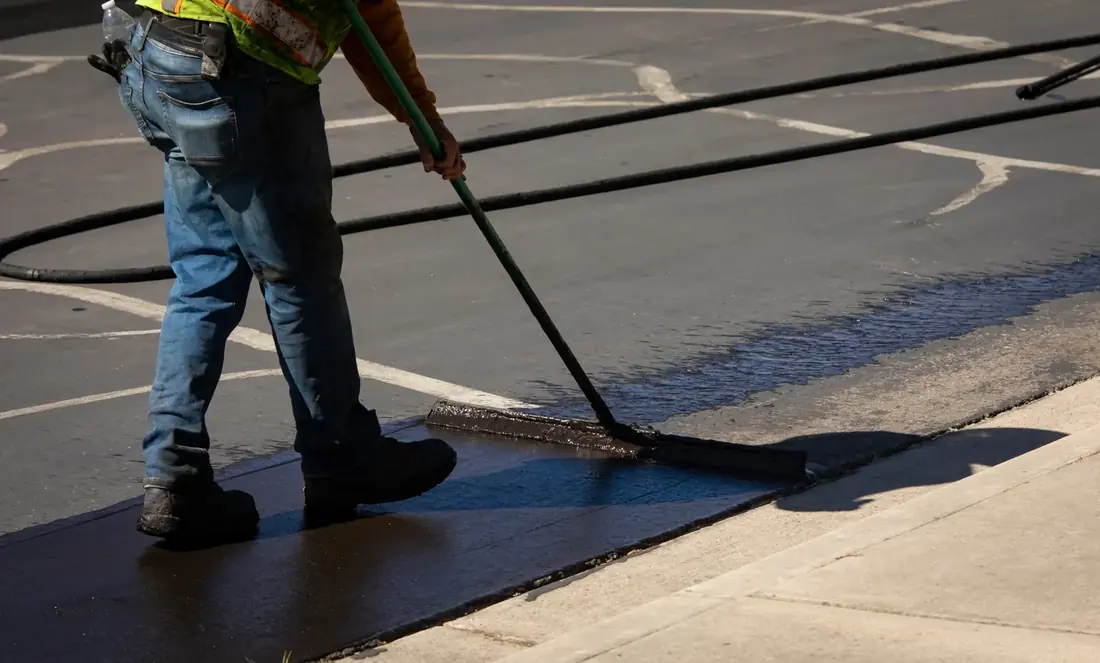
The real sealcoating benefits for commercial lots
The obvious benefits are protection and appearance, but it goes further than a darker surface. A fresh sealcoat preserves the top layer of the asphalt, makes your striping stand out, and gives you a surface that's easier to keep clean. For a business, the parking lot is the first thing customers see. A gray, cracked lot says "nobody's taking care of this place" before anyone walks in the door.
- UV protection: Blocks the sun from drying out and weakening the binder.
- Water resistance: Rain runs off instead of soaking into hairline cracks.
- Oil and fuel resistance: Drips and spills don't soak in as fast on a sealed surface.
- Curb appeal: A rich black finish makes an older lot look clean and even.
- Easier upkeep: Dirt, leaves, and spills come off a smooth sealed surface more easily.
- Better visibility: Fresh parking lot striping on top of new sealcoat pops, which helps traffic flow and pedestrian safety.
To be straight with you: sealcoating doesn't fix everything. If the pavement has base failure, widespread "alligator" cracking, deep potholes, or drainage problems, those need to be fixed first. Think of sealcoating as sunscreen for healthy or repairable asphalt, not a replacement for rebuilding it. If your lot is past that point, we'll tell you.
How Central Texas weather changes the maintenance plan
Long heat, strong sun, and the occasional gully-washer are hard on asphalt. The surface expands and contracts with the heat, dries out, and then gets hit with fast-moving water during storms. Even pavement that looks solid can have tiny openings that let water and debris in.
Austin-area properties take the worst of it on big, unshaded retail and office lots, where the surface heats up for hours every afternoon. If you're comparing asphalt sealcoating Austin contractors, ask how they plan around temperature, humidity, rain in the forecast, and how long the lot stays closed. Rushing a job ahead of a storm or sealing over a dirty surface cuts how long the coating lasts.
Even within Central Texas, no two lots are the same. A shaded church lot in Georgetown wears differently than a wide-open shopping center in Austin with delivery trucks cutting across it every day. The schedule should follow the lot, not a one-size-fits-all calendar.
When should you sealcoat asphalt?
Most asphalt should be sealcoated every two to three years. High-traffic commercial areas may need it every 18 to 24 months. The right timing depends on age, traffic, sun exposure, drainage, and whether cracks or oil stains are already showing. The rule of thumb: sealcoat before the pavement turns gray, brittle, and heavily cracked, not after it has already started to fail.
Brand new asphalt needs several months to cure before it's ready for a first sealcoat. After that, follow the condition of the pavement, not just the calendar. A lightly used, shaded lot won't need the same schedule as a busy apartment entrance or a restaurant drive-thru lane.
Signs your lot is overdue:
- The color has faded from black to gray. That's oxidation and sun damage.
- Fine cracks are spreading. Small cracks are how water gets in.
- Water doesn't run off like it used to. Poor runoff speeds up surface damage.
- The surface feels rough or loose. Loose stone means the top layer is wearing away.
- Oil stains are soaking in. Unprotected asphalt absorbs chemicals faster.
- The striping is hard to see. That's usually a sign it's time for sealcoating and restriping together.
For weather, sealcoating works best when it's above 50°F and the forecast stays dry during the job and for the next 24 to 48 hours. In Central Texas, late spring and early fall usually give better conditions than the peak of summer or stormy stretches.
What happens during a professional sealcoating project?
A professional sealcoating job is a lot more than rolling a black coat over the asphalt. The surface has to be prepped, problems fixed, nearby areas protected, the sealer applied evenly, and enough cure time given before traffic comes back. Skip the prep and the coating won't last.
Here's how we run a sealcoating project:
- Inspection: Check the pavement for cracks, potholes, drainage problems, oil spots, and weak areas.
- Cleaning: Remove dirt, grass, loose stone, and debris so the sealer bonds properly.
- Crack filling: We fill active cracks before coating so water can't keep working its way under the new seal.
- Oil spot priming: We prime oil-stained areas so the sealcoat bonds instead of peeling off those spots.
- Application: Apply one or more coats depending on the surface and how much traffic it gets.
- Curing and reopening: Keep the area closed until the coating has cured enough for cars and foot traffic.
- Restriping: Put the stall lines, ADA markings, fire lanes, and arrows back down once the coat has cured.
If you're a property manager, communication is part of the job too. Tenants, customers, staff, or residents need advance notice about closures and where to park instead. A well-planned project keeps disruption low and prevents tire marks and tracking on the fresh coat.
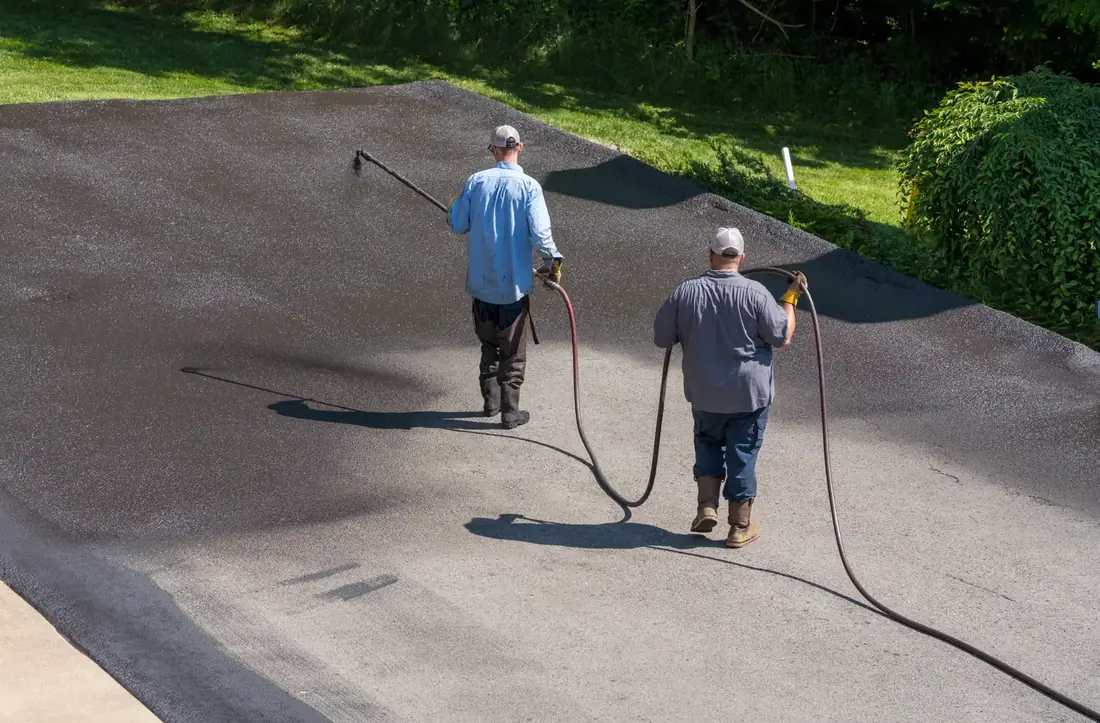
DIY driveway sealcoating vs. professional sealcoating
DIY driveway sealcoating with buckets from the hardware store can work on a small home driveway in good shape. It doesn't scale to a commercial property. On a parking lot, mistakes are easy to see and hard to fix: coating too thick, sealing over dirt, ignoring oil stains, or getting caught by rain leaves streaks, peeling, and thin spots that your customers drive over every day.
Retail centers, churches, schools, apartment communities, private roads, and industrial lots need proper prep, the right equipment, consistent application, traffic control, crack repair, and often two coats. That's where professional sealcoating pays for itself.
| Option | Best fit | Main advantage | Watch out for |
|---|---|---|---|
| DIY sealcoating | Small, simple home driveways | Lower upfront cost | Uneven results; not practical on a commercial lot |
| Professional sealcoating | Parking lots and higher-traffic pavement | Proper prep, equipment, and a consistent finish | Needs scheduling and lot closure |
| Repair, then sealcoat | Cracked or damaged asphalt | Coating lasts much longer | Adds cost up front, but protects the investment |
| Replacement | Failed pavement or base problems | Fixes the deeper structural issue | Far higher cost and disruption |
Cost is the main reason preventive work makes sense. Sealcoating costs a small fraction of what full asphalt replacement does. Your actual price depends on lot size, condition, layout, how much crack repair is needed, materials, and traffic control. That's why we measure your lot and give you a real number instead of a ballpark.
Choosing the right sealer and contractor
Not all sealcoat products are the same. The main types are coal tar emulsion, asphalt emulsion, and acrylic. Coal tar has long been known for resisting fuel and oil, but it's also a big local issue: the City of Austin banned coal tar-based pavement sealants in 2006 after studies linked them to toxic runoff in area creeks and Lady Bird Lake. If your property is in Austin, the sealer has to be a non-coal-tar product. Acrylic sealers show up on some specialty and decorative jobs, but they aren't the default for a standard parking lot.
What we use: Texmark Pavement applies a high-solids, polymer-modified emulsion. "High-solids" means more actual protective material goes down on your lot and less water evaporates away, so you get a thicker, tougher film. The polymer modification helps the coating stay flexible and hold up to the intense UV and summer heat we get in Central Texas.
Don't pick based on a product name alone. Ask your contractor what they recommend for your pavement, your traffic, and your location, and why. A good contractor will explain prep, crack treatment, drying time, how many coats, and how weather affects the schedule. They should also be upfront about what sealcoating can and can't fix.
Questions to ask before you approve a bid:
- Did they actually look at the pavement before quoting?
- Does the bid spell out cleaning and crack filling?
- Will oil spots be treated or primed?
- How many coats are included, and is that right for your traffic?
- What weather would push the job to another day?
- How long do cars need to stay off the surface?
- Is restriping included or quoted separately?
- Are repairs priced separately from the sealcoating?
These questions let you compare bids fairly. The lowest price isn't the best deal if it skips prep, waters down the material, or schedules your lot into a rainstorm.
Pavement maintenance tips between sealcoating visits
Sealcoating works best as part of a bigger maintenance plan. A few habits keep your lot cleaner, safer, and easier to protect when the next coat comes around. The goal is simple: less standing water, cracks that don't spread, and nothing soaking into the surface.
- Sweep or blow off leaves, gravel, and dirt before they trap moisture.
- Clean up oil and fuel spills quickly.
- Adjust sprinklers that keep soaking the pavement.
- Fill small cracks before they widen.
- Watch for low spots where water ponds after rain.
- Trim grass and plants along the pavement edges.
- Don't drag dumpsters, trailers, or sharp metal across the surface.
- Walk the lot after heavy storms or unusual heavy traffic.
For commercial properties, keep a simple pavement log with dates for crack filling, sealcoating, restriping, drainage work, and repairs. It makes budgeting easier and helps you spot repeat problems, like one corner that cracks after every big rain. If you're also tracking marking compliance, our pavement marking TX guide covers what to keep on file.
A smart sealcoating plan protects more than pavement
Sealcoating isn't about making asphalt look new for a few months. In Central Texas, it's a practical defense against sun, heat, water, and daily wear. Done at the right time, with crack repair, cleaning, and good traffic control, it extends the life of your lot and lowers the odds of a big repair bill.
For businesses and property managers, professional sealcoating means better curb appeal, safer traffic flow, and maintenance you can actually plan for. Texmark Pavement serves Georgetown, Austin, Liberty Hill, San Antonio, and the surrounding Central Texas area. We'll look at your lot and tell you plainly what it needs next. The best time to sealcoat is before the pavement looks beyond saving, while a protective layer can still do its job.
Get a Free Sealcoating Estimate
Related reading: 5 Essential Benefits of Parking Lot Re-Striping and Sealcoating
Free Estimate
Get Your Free Parking Lot Estimate
Tell us about your lot and we'll email a price back to you within one business day.